
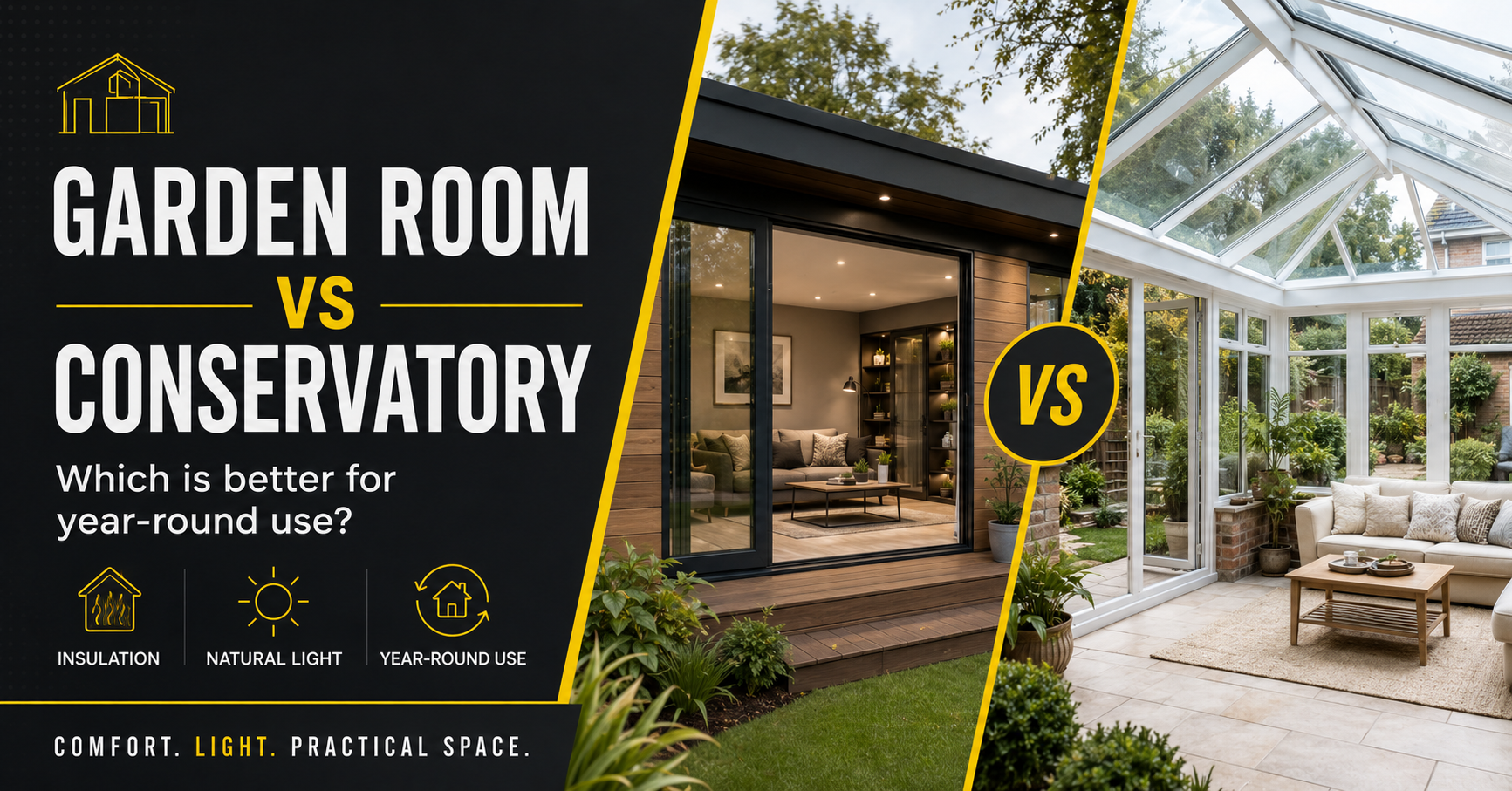
For reliable year-round use, a well-insulated garden room will usually be the stronger choice. Conservatories offer excellent natural light and a direct connection to the house, but their large glazed areas can make temperature control more challenging through winter and during hot summer spells. Comparing conservatories and garden rooms properly means looking beyond appearance and considering insulation, heating, privacy, everyday purpose and how often the space will actually be used.
For homeowners who want a separate office, gym, studio or retreat that remains practical throughout the seasons, professionally built bespoke garden rooms in West Sussex can provide a more room-like environment. A conservatory may still be the better option when daylight and a seamless connection to the existing home matter most.
Garden Room vs Conservatory at a Glance
Although both options create additional usable space, they achieve it in very different ways.
A conservatory is generally attached to the main property and traditionally uses a high proportion of glazing across its walls and roof. It feels visually connected to both the house and garden.
A garden room is normally a separate structure positioned within the garden. Modern versions can be constructed more like compact standalone buildings, with insulated walls, flooring, roofing, glazing, electrics and interior finishes suited to their intended use.
| Feature | Garden Room | Conservatory |
| Year-round comfort | Strong when properly insulated | Depends heavily on glazing, roof and heating |
| Location | Usually detached from the house | Usually attached to the house |
| Natural light | Customisable | Typically very high |
| Privacy | Usually greater | More connected to the home |
| Home office suitability | Excellent with the right specification | Good, but temperature and glare need consideration |
| Garden connection | Immersive, positioned within the garden | Strong visual connection from the house |
| Internal feel | Can feel like a conventional room | Usually lighter and more glazed |
| Flexibility | Office, gym, studio, leisure room and more | Dining, sitting, entertaining or garden-facing living space |
Neither structure is automatically better in every situation. The deciding question is what you want the additional space to do on an ordinary January morning as well as on a sunny afternoon in June.
Why Garden Rooms Often Work Better Throughout the Year
The greatest advantage of a purpose-built garden room is that its construction can be designed around comfort from the beginning.
Instead of relying heavily on glass, the building can combine insulated walls, an insulated floor and roof, suitable windows and doors, ventilation and an appropriate heating arrangement. This gives the designer more control over how the internal environment responds to seasonal changes.
That distinction becomes especially noticeable when the room is intended for daily rather than occasional use.
A garden office, for example, needs to be comfortable enough for someone to work in for several hours. A gym may need both insulation and ventilation. A creative studio could require stable lighting, plenty of sockets and usable wall space. A relaxation room may benefit from privacy and acoustic separation from the main household.
This is one reason the modern garden room has moved far beyond the traditional image of a decorated shed at the end of the lawn.
Why Conservatories Can Be Harder to Keep Comfortable
A conservatory’s biggest visual strength can also create its biggest practical challenge: glazing.
Large areas of glass bring daylight deep into the room and create an open view of the garden. However, glass behaves differently from an insulated solid wall. The exact performance depends on the glazing system, roof construction, orientation, ventilation, shading and heating.
A south-facing garden conservatory, for instance, may receive substantial solar gain during summer. Without suitable shading and ventilation, that can make the room less pleasant during the hottest part of the day.
During colder weather, an older or poorly specified conservatory may also lose heat more readily than a room with a greater proportion of insulated construction.
Modern conservatories can perform much better than older examples, particularly when high-performance glazing, improved roofing and suitable temperature-control measures are included. The key is specification. It should not be assumed that every conservatory behaves the same way.
Insulation Is the Real Year-Round Test
If you expect to use an additional room twelve months of the year, insulation deserves more attention than almost any decorative choice.
Good thermal design is not simply about making a space warm. It helps the room respond more predictably as outside temperatures change.
For a garden room, the building envelope can usually be planned as a complete system. Walls, floor, roof, windows and doors should work together rather than being considered separately.
A properly designed garden room conservatory alternative may include:
- Insulated wall, floor and roof construction
- Quality double glazing
- Weather-resistant external finishes
- Controlled ventilation
- Suitable heating
- Thoughtful positioning of doors and windows
Insulation also matters in summer. Slowing heat transfer through the building fabric can help create a more stable environment, although ventilation, orientation and shading remain important.
This is where basic garden buildings and genuinely year-round garden rooms begin to separate. Attractive cladding alone does not make a building suitable for daily winter use.
Which Is Better as a Home Office?
For many homeowners, the home office is where the garden room has a clear advantage.
Working away from the main house creates a useful physical boundary between professional and personal life. You can walk into the garden, enter the office and feel that you have arrived somewhere specifically intended for work.
The additional separation can also reduce household interruptions.
A bespoke office can be designed around desk positioning, internet requirements, storage, sockets, lighting, heating and background noise. Window placement can provide garden views without putting a computer screen directly in strong sunlight.
A conservatory can certainly function as an office, particularly if it has already been built and sits underused. However, glare, privacy and seasonal temperature changes need careful consideration before committing to it as a full-time workspace.
For a room that will be occupied five days a week throughout the year, comfort should carry more weight than simply having abundant daylight.
What About a Gym or Exercise Space?
A garden room also makes sense for homeowners who want a dedicated exercise area.
Gym equipment can take over a spare bedroom surprisingly quickly. Moving it into a purpose-designed room gives the equipment a permanent home without sacrificing living space inside the property.
The structure needs to suit the type of exercise being undertaken. Flooring, ventilation, ceiling height, electrical requirements, privacy and usable circulation space all matter.
A conservatory in the garden-facing part of the house can feel bright and energising, but anyone placing exercise equipment in a highly glazed room should consider privacy and temperature management.
A detached garden room provides greater freedom to position windows where daylight is useful while retaining more solid wall area for mirrors, storage or equipment.
Privacy and Separation Can Change How the Room Feels
One difference between a conservatory garden room and a detached garden room is psychological as much as architectural.
Because a conservatory is connected to the house, it remains part of household activity. That is ideal for a dining area, family sitting room or play space where connection is desirable.
A garden room creates separation.
That can be beneficial for focused work, music, hobbies, reading or exercise. It can also give different members of the household more usable space without competing for the same rooms.
The garden itself becomes part of the transition. Walking several metres from the back door to a separate building sounds minor, but it can make the room feel noticeably more independent.
Homeowners considering either option can learn more about the approach of Sussex County Construction and the types of residential projects the team handles across Sussex.
Natural Light: The Conservatory Still Has an Advantage
If maximum daylight is the priority, the conservatory remains difficult to beat.
Its defining feature is the relationship between glass and garden. It can create a bright transition between inside and outside and works particularly well where homeowners want somewhere to sit, dine or entertain while enjoying views across the garden.
A garden room can still be exceptionally bright. Large windows, glazed doors, rooflights and carefully chosen orientation can all increase natural light.
The difference is control. Rather than glazing most of the structure automatically, a bespoke garden room allows the amount and position of glass to respond to the room’s purpose.
A computer-based office does not necessarily benefit from glass on every side. A yoga studio might. An art room may require a particular quality of light. A cinema or gaming room may need comparatively little.|
More glazing is not always better. The right glazing is better.
Avoiding Garden Room Regret
Searching for “garden room regret” often reflects a sensible concern: will the building actually be used once the novelty has disappeared?
The best protection against disappointment is to design the room around a real purpose rather than treating the project primarily as a visual garden feature.
Before deciding on the specification, think carefully about how the room will function on a wet winter evening, during a warm summer afternoon and on an ordinary working day.
Common issues worth addressing during the design stage include:
- Insufficient insulation for the intended level of use
- Too few electrical sockets
- Poor internet connectivity
- Excessive glazing or unwanted glare
- Limited ventilation
- Choosing a size that works for furniture on paper but feels cramped in practice
It is also worth considering how requirements might change. A garden office today could later become a study space, hobby room or fitness room. Building in sensible flexibility can give the room a longer useful life.
Which Option Gives You More Design Freedom?
Garden rooms generally offer considerable freedom because they can be designed around both the available outdoor space and the intended function.
The proportions, cladding, glazing, internal arrangement and relationship with landscaping can all be considered together.
This is particularly useful in gardens where a standard rectangular building would look awkward or consume too much usable outdoor space.
A conservatory has different design constraints because it needs to connect successfully to the existing property. Door openings, external walls, rooflines and the architecture of the house influence the final result.
That connection can be an advantage when the goal is to extend an existing kitchen, dining area or living space visually towards the garden.
If independence is more important, the garden room usually provides more possibilities.
Garden Room or Conservatory for Entertaining?
This depends heavily on how you like to entertain.
A conservatory works naturally as an extension of indoor social areas. Guests can move from the kitchen or living room directly into a bright garden-facing space without going outside.
For meals, drinks or family gatherings, that connection is convenient.
A garden room creates a destination instead.
It could become a garden bar, games room, small cinema, music room or relaxed entertaining space away from the main property. Opening glazed doors during pleasant weather can connect the room to patios, planting and other outdoor areas.
Rather than asking which option is universally better, consider the movement between the house, garden and new space.
Planning and Positioning Need to Be Considered Early
The fact that a building sits in a garden does not mean every design can simply be constructed without further checks.
Requirements can vary according to factors such as the property’s location, the size and height of the proposed structure, its position within the site and how the space will be used.
A professional builder should therefore assess the project before construction begins rather than treating planning as an afterthought.
Positioning matters just as much.
Sunlight, neighbouring properties, existing trees, access for construction, drainage and the relationship between the building and the main house can all influence the best location.
Working with an experienced family-run Sussex construction team can also make it easier to consider the complete project rather than viewing the garden building in isolation.
Garden Rooms Conservatories and the Sussex Climate
Homes in Sussex experience the usual British mixture of cool winters, rain, wind, warm spells and rapidly changing conditions.
A room designed mainly around how it looks during pleasant weather risks being disappointing for much of the rest of the year.
For genuine year-round use, the design should consider weather resistance, insulation, glazing, heating, ventilation and the way the building meets the ground.
External materials also deserve careful selection. A garden room is exposed on all sides, so the roof, cladding, doors, windows and details around openings need to cope with repeated seasonal exposure.
The finished interior may look similar to a room inside the house, but the structure supporting it still has to perform as an external building.
So, Is a Garden Room Better Than a Conservatory?
For year-round daily use, a purpose-built insulated garden room will often be the more versatile option.
It offers greater privacy, flexible glazing, substantial insulated wall space and the freedom to create a room around a specific purpose such as working, exercising or pursuing a hobby.
Choose a garden room if your priorities are:
- A dedicated home office or studio
- Separation from the main house
- Flexible year-round use
- Greater privacy
- A highly customisable internal layout
A conservatory remains an excellent choice where the goal is different. If you want to increase the sense of space at the rear of the house, maximise natural light and maintain a direct relationship between indoor living areas and the garden, it may suit the property beautifully.
The decision between garden rooms conservatories should therefore begin with function rather than style.
Ask what you expect to do in the room, how many hours a week you will use it and what comfort will mean in both January and July. Those answers usually make the right direction much clearer.
Frequently Asked Questions
Can a garden room really be used all year?
Yes, provided it has been designed and constructed for year-round occupation. Insulation, glazing, weatherproofing, ventilation and suitable heating all contribute to comfort. A lightweight summerhouse and a fully insulated garden room are very different structures, so specifications should be compared carefully.
Is a garden room warmer than a conservatory in winter?
A well-insulated garden room can be easier to heat consistently because it normally contains more insulated wall and roof area and less glazing. However, performance varies between individual buildings. A modern, well-designed conservatory may perform much better than an older glazed structure.
Is a conservatory too hot to use in summer?
Not necessarily. Orientation, glazing, roof construction, ventilation and shading all affect summer comfort. A heavily glazed conservatory receiving strong direct sunlight may need greater attention to heat management than a garden room with a more balanced combination of insulated walls and windows.
Can I use a garden room as a permanent home office?
A properly specified garden room can make an excellent home office. Plan the building around practical requirements such as heating, insulation, power, lighting, internet connectivity, desk positioning, storage and privacy rather than treating these as additions after construction.
Which adds more useful space, a garden room or conservatory?
Both can add highly usable space, but they serve different purposes. A conservatory extends the experience of the main house, while a garden room creates a separate destination elsewhere on the property. The more useful choice depends on how your household needs the space to function.
Can a garden room look like part of my existing property?
Yes. Materials, roof form, window proportions, colour and landscaping can be chosen to complement the main home. Alternatively, the room can deliberately use a contemporary design to create a distinct feature within the garden.
Should I choose a garden room or conservatory for a small garden?
Either may work, but the design needs to protect valuable outdoor space. A compact garden room can be tailored to a particular corner or boundary arrangement, while a conservatory uses space immediately beside the house. The best option depends on the garden layout and how much open space you want to retain.
Choosing a Space You Will Still Enjoy Years From Now
The strongest choice between a conservatory in garden-facing living space and a standalone garden room is the one that matches how you actually live.
For homeowners seeking a bright extension of the house, a conservatory still has plenty to offer. For those wanting an insulated, private and adaptable space that can function independently throughout the year, the garden room has a compelling advantage.
Good results begin with the less glamorous questions: where will the room sit, how will it be insulated, where will daylight enter, what will happen in winter, and how might its use change later?
Getting those decisions right early can turn an attractive addition into a genuinely useful part of the property.
If you are considering a garden room in West Sussex and want to understand what will work with your garden, property and intended use, you can contact our construction team to discuss the project and explore the practical options before deciding on a design.
0 Comments