
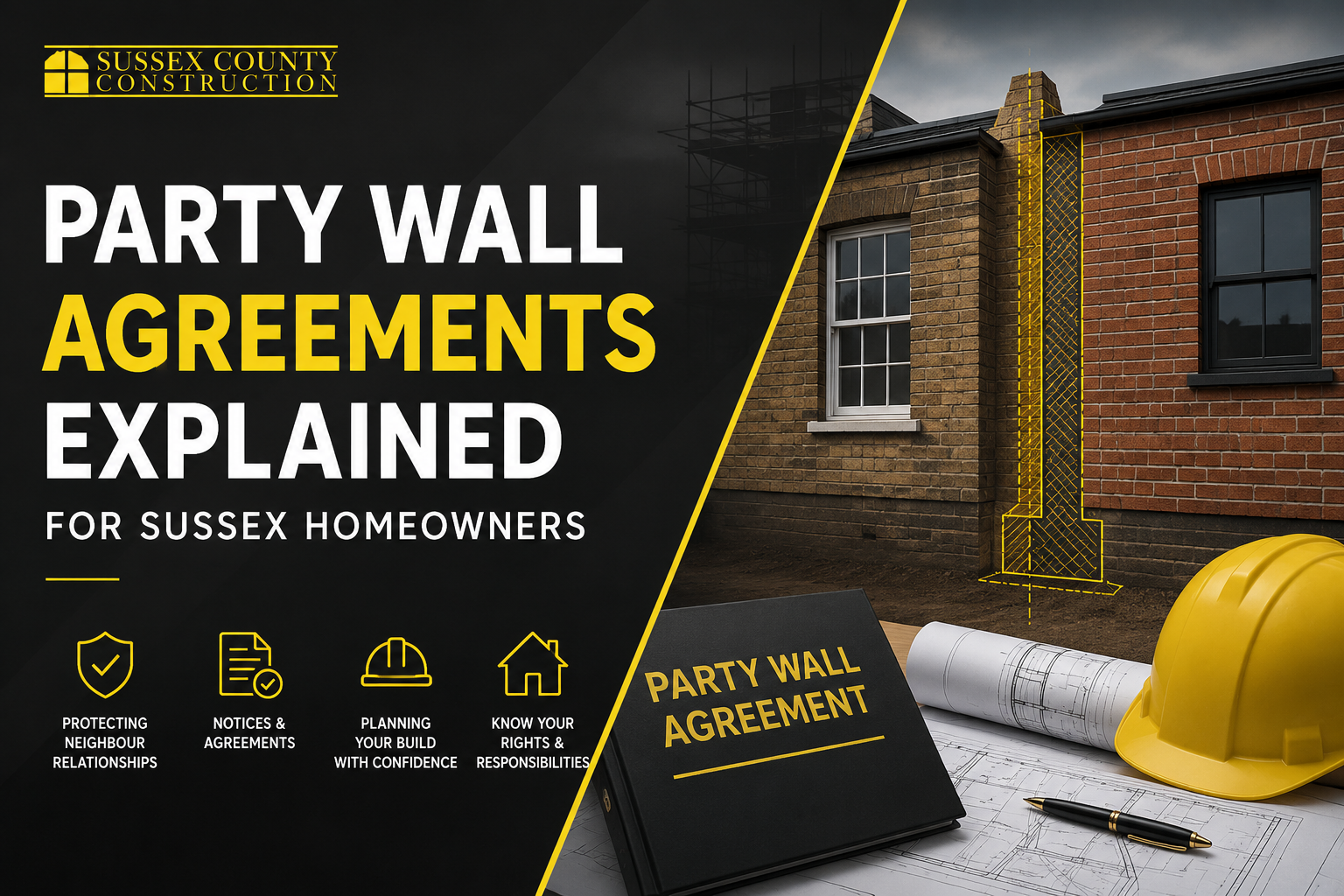
Party Wall Agreements are relevant when building work affects a shared wall, a boundary wall or foundations close to a neighbouring property. For Sussex homeowners planning house extensions, loft work or structural alterations, the key point is simple: the Party Wall etc. Act 1996 may require formal notice before work begins, even if planning permission and Building Regulations approval are already in place. This guide explains when the Act applies, what a party wall notice should cover, what happens if a neighbour dissents, and how a party wall award helps control the work.
The process is designed to protect both sides. It gives the building owner a legal route to carry out certain works while giving the adjoining owner information, safeguards and a formal dispute-resolution procedure. It does not automatically mean there is a disagreement, and many projects proceed after the neighbour gives written consent.
What Is a Party Wall?
A party wall is commonly a wall shared by two properties, such as the wall between terraced or semi-detached houses. The Party Wall etc. Act also recognises certain walls that stand astride a boundary and some structures separating different parts of a building.
A masonry garden wall that stands on the boundary can be a “party fence wall”. A timber fence or hedge is not a party fence wall under the Act. A wall can also be treated as a party wall for only part of its length, depending on how neighbouring buildings use it.
When Is a Party Wall Agreement Required?
Homeowners often ask, “when is a party wall agreement required?” Strictly speaking, the Act requires notice where qualifying work is proposed. A separate written agreement or party wall award depends on how the adjoining owner responds.
The Act commonly applies in three situations:
- work directly to an existing party wall or party structure;
- building a new wall at or astride the boundary between properties;
- excavation close to a neighbouring building where the excavation reaches specified depths.
The government’s guidance identifies those same three broad categories.
For a homeowner, the practical question is not simply whether the project is “near the neighbour”. The design, excavation depth, foundation position and structural connection to the shared wall all matter.
Common Sussex Projects That Can Trigger the Act
Party wall issues often arise during extensions, loft conversions, structural alterations and basement work.
A rear or side extension may involve digging new foundations close to the neighbouring house. A loft conversion can involve cutting steel beams into a party wall. Removing or rebuilding a chimney breast may affect a shared structure. Raising a party wall, underpinning it or extending it downwards can also fall within the Act. Government guidance specifically lists cutting into a party wall for beam bearings as a common example associated with loft conversions.
Homeowners considering loft conversions should therefore check the structural design before work starts rather than waiting until steelwork is ready to be installed.
The 3-Metre and 6-Metre Excavation Rules
Extensions can trigger the Act without touching the party wall itself.
A notice may be required where you excavate within 3 metres of a neighbour’s building or structure and your excavation goes deeper than the bottom of their foundations. A separate 6-metre test applies where the excavation intersects a 45-degree line drawn down from the bottom of the neighbouring foundations towards the proposed excavation.
This is one reason foundation drawings are important. Measuring the distance between the two houses alone does not provide the full answer because the depth of both sets of foundations can be critical.
What Is a Party Wall Notice?
A party wall notice is the formal notification served by the building owner on the relevant adjoining owner or owners.
A valid notice should identify the building owner, describe the proposed work and state when the work is intended to begin. Certain excavation notices also require plans and sections showing the position and depth of the proposed excavation.
Different notice periods apply. Work to an existing party structure generally requires at least two months’ notice. Work involving the line of junction and qualifying excavation generally requires one month’s notice. Government guidance also states that the adjoining owner is normally expected to reply within 14 days.
A casual conversation over the garden fence is useful for neighbour relations, but it is not a substitute for a correctly served notice where the Act applies.
What Happens After a Party Wall Notice Is Served?
The adjoining owner can consent in writing, dissent or, for certain notices, fail to respond within the required period.
Written consent is often the simplest outcome. It means the neighbour agrees to the works described in the notice. That does not remove the building owner’s responsibility to carry out the works properly or make good relevant damage.
If the adjoining owner dissents, or is deemed to dissent because they do not respond to a party structure or excavation notice within the required time, the Act’s dispute-resolution procedure begins. A surveyor or surveyors are then appointed to settle the matters covered by the Act.
What Is a Party Wall Award?
A party wall award is a formal document prepared by the appointed surveyor or surveyors after a dispute has arisen under the Act.
It can describe the authorised work, how and when it should be carried out, protective measures required and arrangements for access or inspection. It often includes a schedule recording the condition of the adjoining property before work begins.
One Surveyor or Two?
Both owners can agree to appoint one “Agreed Surveyor”. Alternatively, each owner can appoint their own surveyor. Where two surveyors are appointed, a third surveyor is selected in case a matter cannot be agreed between them.
The surveyor’s role under the Act is not simply to argue for whoever appointed them. The process is intended to produce a fair award dealing with the rights and protections of both properties.
What Does a Party Wall Agreement Example Usually Cover?
Homeowners searching for a party wall agreement example are often expecting a short contract signed by both neighbours. In practice, the paperwork depends on the stage of the process. Where a neighbour consents, the written response to a valid notice may be relatively straightforward. Where there is a dispute, the party wall award is much more detailed.
A typical award may address the approved works, working methods, protection of the adjoining property, access arrangements, working hours where relevant, a schedule of condition and procedures for dealing with damage. The exact wording should reflect the actual project. Copying a generic document from another extension can be risky because foundation depths, structural details and adjoining properties differ.
Party Wall Agreements and Planning Permission Are Separate
Party wall procedures do not replace planning permission or Building Regulations.
A homeowner can have planning permission and Building Regulations approval but still need to comply with the Party Wall etc. Act. Equally, work covered by the Act may not always require planning permission. Government guidance expressly treats these as separate legal and regulatory processes.
For local projects, experienced building services in Worthing can help coordinate the construction sequence with drawings, structural requirements and other approvals, while specialist party wall advice should be obtained where the Act needs formal interpretation.
What If Your Neighbour Refuses to Agree?
A neighbour cannot necessarily stop lawful work simply by saying they do not like the project.
If they dissent from qualifying work, the surveyor process is used to resolve matters under the Act. This can influence how the work is carried out, how the adjoining property is protected and what records are made before construction begins.
The Act does not give a party wall surveyor power to determine every disagreement between neighbours. Boundary ownership disputes, planning objections and unrelated private rights may need to be handled through different routes.
What Happens If You Start Without Serving Notice?
Starting qualifying work without serving the required notice can create avoidable risk.
Government guidance explains that the Act itself does not contain an enforcement procedure for failure to serve notice, but an adjoining owner may seek a court injunction to stop work or pursue other legal remedies. Trying to correct the paperwork after excavation or structural work has already started is much harder than checking the position during design.
Homeowners undertaking work in denser areas, including projects requiring construction services in Brighton, may have several neighbouring structures close to new foundations. Early review is particularly useful where access is tight or adjoining properties have different floor or foundation levels.
How to Prepare Before Serving a Notice
The party wall process is easier when the project information is settled before notices are sent.
Before proceeding, confirm:
- the proposed structural work and foundation design;
- the location of boundaries and adjoining buildings;
- which owners need to receive notice;
- which sections of the Act may apply;
- the intended construction start date;
- whether professional party wall advice is appropriate.
Do You Always Need a Party Wall Surveyor?
No. If a valid notice is served and the adjoining owner gives written consent, there may be no need for a party wall award or surveyor-led dispute procedure. A surveyor becomes relevant when a dispute arises or when professional advice is needed to establish whether the Act applies and how notices should be handled.
Because the legal definition of “surveyor” under the Act is broad, homeowners should still look for someone with suitable construction knowledge and practical party wall experience. Government guidance notes that the appointed person should understand both construction and the procedures under the Act.
FAQs About Party Wall Agreements
When do you need a party wall agreement for an extension?
You may need to follow the Party Wall etc. Act where extension foundations are close enough and deep enough to affect neighbouring structures, where a new wall is proposed at the boundary, or where the work directly affects an existing party wall.
Is a party wall notice the same as a party wall award?
No. The notice informs the adjoining owner about proposed qualifying work. A party wall award is produced by the appointed surveyor or surveyors when the Act’s dispute-resolution procedure is required.
Can my neighbour refuse a party wall agreement?
Your neighbour can dissent from the notice. That normally triggers the surveyor procedure rather than giving the neighbour an automatic right to permanently prevent work that the Act allows.
Do I need a party wall agreement for a loft conversion?
You may do. Loft conversions commonly involve steel beams supported by party walls, and cutting into a party wall to take a beam bearing is one of the works covered by the Act.
Do detached houses ever need Party Wall Agreements?
Yes. A detached house can still trigger the Act if proposed work involves a boundary wall or qualifying excavation near a neighbouring building. The houses do not have to share a wall.
Is a “parting wall agreement” different from a party wall agreement?
No. “Parting wall agreement” is a common search or wording mistake. The relevant UK legislation is the Party Wall etc. Act 1996, and the usual terms are party wall notice, consent and party wall award.
Plan Party Wall Matters Before Construction Starts
Party Wall Agreements are best treated as part of pre-construction planning, not paperwork to deal with once builders are on site. The right time to check the Act is when structural drawings, foundation depths and the construction programme are becoming clear.
For Sussex homeowners, that means checking shared walls, boundaries and nearby foundations alongside planning and Building Regulations requirements. If the Act applies, serving the correct notice early gives neighbours time to respond and gives the project team time to resolve any formal dispute before work begins.
If you are planning structural alterations or an extension and want the construction implications reviewed before work starts, you can contact Sussex County Construction to discuss the proposed project and determine which specialist assessments may be needed.
0 Comments