
Understanding Loft Conversion Building Regs
A loft conversion is one of the best ways to add valuable space and increase property value without moving to a new house. But many homeowners feel confused or even stressed when it comes to loft conversion building regulations in the UK. These rules are essential because they ensure your project is safe, energy-efficient, and legally compliant.
At Sussex County Construction, an expert team of builders in Worthing, West Sussex, has helped countless homeowners complete stress-free loft projects. That’s why we’ve created this easy-to-follow guide that explains everything about loft conversion building regs — from the basic requirements to the completion certificate. By the end, you’ll have a clear roadmap for planning your loft and avoiding costly mistakes.
What are Loft Conversion Building Regs?
Loft conversion building regulations are official standards set by UK authorities to ensure your new loft space is safe, healthy, and energy-efficient. In simple words:
“ They prioritise structural safety, fire protection, and energy performance.”
Although the loft conversion building regs apply across the UK, the exact rules can vary depending on your property and the type of loft you choose. That’s why it’s important to understand the basics before you begin.
For example, a VELUX loft conversion usually requires fewer structural changes, so the regulations are lighter. On the other hand, a hip gable loft conversion or a dormer loft conversion involves roof extensions, which means stricter rules apply. If you’re considering different loft conversion types, knowing the relevant regulations can save you time and stress.
No matter the design, every project must comply with core building regulations — including minimum headroom, fire safety, insulation, ventilation, plumbing, staircases, and electrical systems. We’ll cover each of these in detail below.
Do I need Planning Permission for a Loft Conversion?
In most cases, you do not need planning permission for a basic project such as a VELUX loft conversion. These usually fall under permitted development rights. However, if your home is located in a conservation area or has restrictions due to local planning rules, it’s best to confirm with your council before starting.
If you’re still unsure, our team at Sussex County Construction can guide you through both planning and building regulations approval, ensuring you don’t face delays later.
What’s The Minimum Requirement for Loft Conversion?
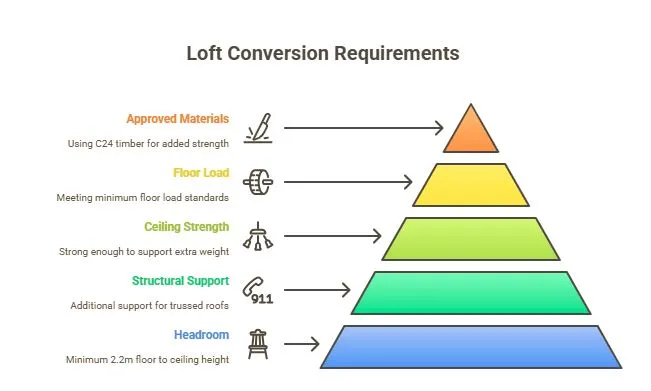
According to UK loft conversion building regulations, you need at least 2.2m headroom from floor to ceiling. Converting traditional cut roof structures like rafters and purlins is easier, while trussed roofs require additional structural support.
Other key requirements include:
- Ensuring the ceiling below is strong enough to support extra weight.
- Meeting minimum floor load standards.
- Using approved materials like C24 timber for added strength.
If you’re planning a bigger upgrade such as a full loft extension and wondering how much is a loft extension, make sure you factor these minimum requirements into your design.
Loft Conversion Building Regs:
- Strong Floor Joists
- Loft Area
- Fire Safety Requirements
- Insulation Requirements
- Ventilation and Safety
- Plumbing Regulations
- Staircase Regulations
- Electrical Regulation
- Party Walk Agreement
- Completion Certificate
Strong Floor Joists:
Floor joists are weight-bearing structures, composed of timber or steel. According to Loft conversion building regs:
- Your floor should be strong enough to support furniture and people.
- The spacing between each joist should be at least 6mm apart according to Local Authority Building Control ( LABC).
- Ensure there is no floor sagging.
- The floor joist span, the distance that a joist spans from one end to the opposite, should be a minimum.
- The “imposed weight”, the weight to be placed on your loft room including its content, should be 1.5kN/m2.
- As for material, C24 timber is the premium-quality timber. It’s also best for supporting additional weight, i.e, more than 1.5kN/m2.
- The floor joists must have 100mm wool insulation between them for energy efficiency.
Loft Area
According to the loft conversion building regs, the loft area for smaller loft space should be 20m2 and for a larger loft space should be 40m2.
- The minimum height for a loft conversion is 2.2 meters for walls and roofing. This space ensures proper installation, ceiling, and comfortable living.
- With a head height lower than 2.2 meters, a loft conversion isn’t possible.
- Also, the water tanks should be waterlight. Their minimum capacity should be 212 liters.
- Next come Chimneys, just to increase your loft area. If you’re considering removing your Chimneys, please note that it’s recommended that you use HETA’s installer to be a part of the Government’s Competent Person Scheme.
Fire Safety Requirements
For a safe and legally compliant loft conversion, you must follow fire building regulations. A recent study by the government of the UK shows that because of legally compliant fire systems, there is a 22% decrease in fire-related deaths.
- The escape route, which in the case of a loft conversion is “loft stairs,” must be fire-resistant for 30 minutes at least. It should be free from hurdles all the time.
- In an unexpected fire case, fire routes can be dangerous to use; that’s why fire doors are a better option. Because they can withstand fire and protect you and your loft. The fire door should resist fire for a minimum of 20 minutes.
- According to Loft conversion building regs, you need to install intumescent strips as well. Especially around the door frame. The strips should be able to withstand a temperature of 200 degrees. As a result, these strips can prevent the spread of fire.
- The next important fire safety requirement for a loft conversion is the installation of smoke alarms. All the smoke alarms should be interlinked with each other. You should install the smoke alarm 7.5m away from the living space. Also, keep them at least 30cm away from the nearest light and wall.
- All the loft material, such as floor, beam, and wall, should be fire-resistant for 30 minutes and should have a 12.55mm thick plasterboard or fire-proof paint to resist fire.
By following these fire safety requirements, your loft and family will remain protected for at least 30 minutes in case of an emergency. If you’re exploring different layouts, our guide to loft conversion staircase options shows how smart stair design can also improve fire safety and escape routes.
Insulation Requirements:
Insulation regulations aim to save fuel and power. As a result, increasing the efficiency of your home and reducing carbon emissions.
- The insulation installed should be 270 mm thick.
- There should be proper ventilation when installing insulation to avoid moisture accumulation.
- There are no specific requirements for material by law. But sheep’s wool is always recommended because of its ability to retain heat and reduce moisture.
- U-value expresses the heat loss or gain rate. It describes insulation efficiency. It’s expressed in watts per square metre per Kelvin (W/m2K).
- The recommended U-value for insulation efficiency is 0.2 (W/m2K).
Windows:
Windows are an important part of loft conversion building regs. They provide natural light, air circulation, and energy efficiency. Regulations state that:
- The U-value should be 1.6 (W/m2K) or lower.
- Windows must carry an energy rating of “B” or higher.
- They should allow adequate ventilation to reduce dampness and mold.
If you’re upgrading your entire property, consider professional Window & Door Installation in UK for long-term performance and compliance.
Plumbing Regulations
If you plan to add a bathroom or wash area, you must follow plumbing regulations. This includes proper foul water drainage and safe connection to the sewage system. During your project, also check that gutters and pipes align with building standards.
For larger projects, such as full property extension services or Bespoke House Extensions in Sussex, plumbing and water management are critical from the start.
Staircase Regulations
Staircases must comply with safety and fire standards. Regulations require:
- Fire resistance for 30 minutes.
- Handrails between 900–1000mm high.
- “Going” between 200–300mm.
- “Riser” between 150–200mm.
- Stair angle under 42 degrees with 2m headroom.
If you’re short on space, check our small loft conversion ideas for creative staircase designs that save room without breaking building regs.
Electrical Regulation
To make your loft a livable space, you need lighting and power points. Now let’s see the loft conversion building regs for electricity:
- Your loft electrical work should prevent electrical shocks and fires.
- Hire an expert electrician to evaluate whether your current system can accept some additional load; otherwise, you may need to rewire your entire home.
Compliance with the electrical regulations ensures the safety of your property and your people.
Party Walk Agreement
If you share a wall with neighbours, you’ll need a Party Wall Agreement before starting construction. This ensures both parties agree on noise, access, and wall changes.
Sussex County Construction has years of experience managing loft conversions in Sussex and can guide you through the party wall process smoothly.
Completion Certificate
Once plumbing, electrics, insulation, and fire safety are checked, an authorised inspector will survey your loft. If everything meets regulations, you’ll receive a completion certificate.
Working with professional loft conversions Worthing experts ensures your project passes inspection the first time.
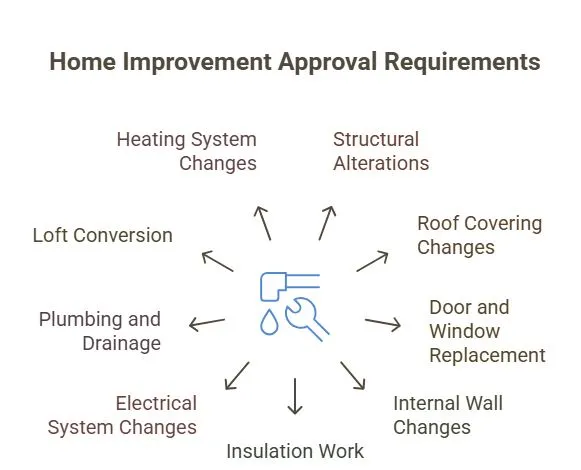
Which Home Improvements Fall Under Building Regulations Approval?
Usually, alteration projects and extension work need building regulations approval. Such as:
- Structural alteration of the roof
- Great changes in roof covering
- Substituting at least 25% of your roof covering.
- You completely replace doors or windows.
- Changing the structure of internal walls, such as building, remodeling, or forming.
- You are planning to insulate a cavity wall.
- Transforming fuse boxes and associated electrics.
- Major drainage or plumbing work, such as adding a kitchen or bathroom.
- Loft conversion that’s affecting more than 25% of the external wall.
- Adding or replacing a heating system.
Why Loft Conversion Building Regs Matter?
- Following loft conversion regs keeps your project safe and future-proof. It ensures proper fire escape, structural stability, and compliance with drainage and electrical systems.
- For homeowners considering other upgrades, we also offer Kitchen renovation services in West Sussex, Bespoke Garden Rooms in Sussex, and Bespoke New Builds.
What is the Process of Getting Building Regs Approval?
You can get building regulation approval in the following way:
- Architects: Can design your loft plan.
- Structural Engineers: Ensure your roof and floor are safe.
- Approved Inspectors: Handle approvals with the council.
If you prefer professional guidance, our building company, Chichester, Expert Building Services in Worthing, and Professional Loft Conversion Services Across the UK teams can help streamline approvals.
How Can I Apply For Loft Conversion Building Regulations Approval?
So, if you choose an approval inspector, just stay updated and enjoy the process. Your inspector will manage everything. But if you’re managing things yourself, write an application to your local council. Simple alterations in the loft may get approved within 5 days. However, if you’re applying for a “ Full Plan”, it usually takes 8 weeks to gain approval.
That’s it! We hope this article answers all your queries related to loft conversion building regs. If you still have any doubt,Sussex County Construction Expert team is always happy to guide!
Conclusion
That’s it! We hope this guide answers all your questions about loft conversion building regulations.
If you’d like to see real results, browse our completed projects or learn more about us.
For expert help, contact Sussex County Construction today for Expert Construction Services in Littlehampton, Professional Construction Services in Bognor, orNew Builds and Renovations in Brighton.
Need a DIY approach? Explore our do-it-yourself loft conversion tips or check pricing guides, such as how much is a loft extension.
Finally, reach us anytime via our contact page — our team is here to help.
0 Comments